Best Technology Stackfor OTT Platform Development
Discover the modern technologies that power successful OTT platforms. From frontend frameworks and backend services to cloud infrastructure, video streaming, security, databases, and AI, learn how the right technology stack helps build a fast, secure, and scalable streaming business.
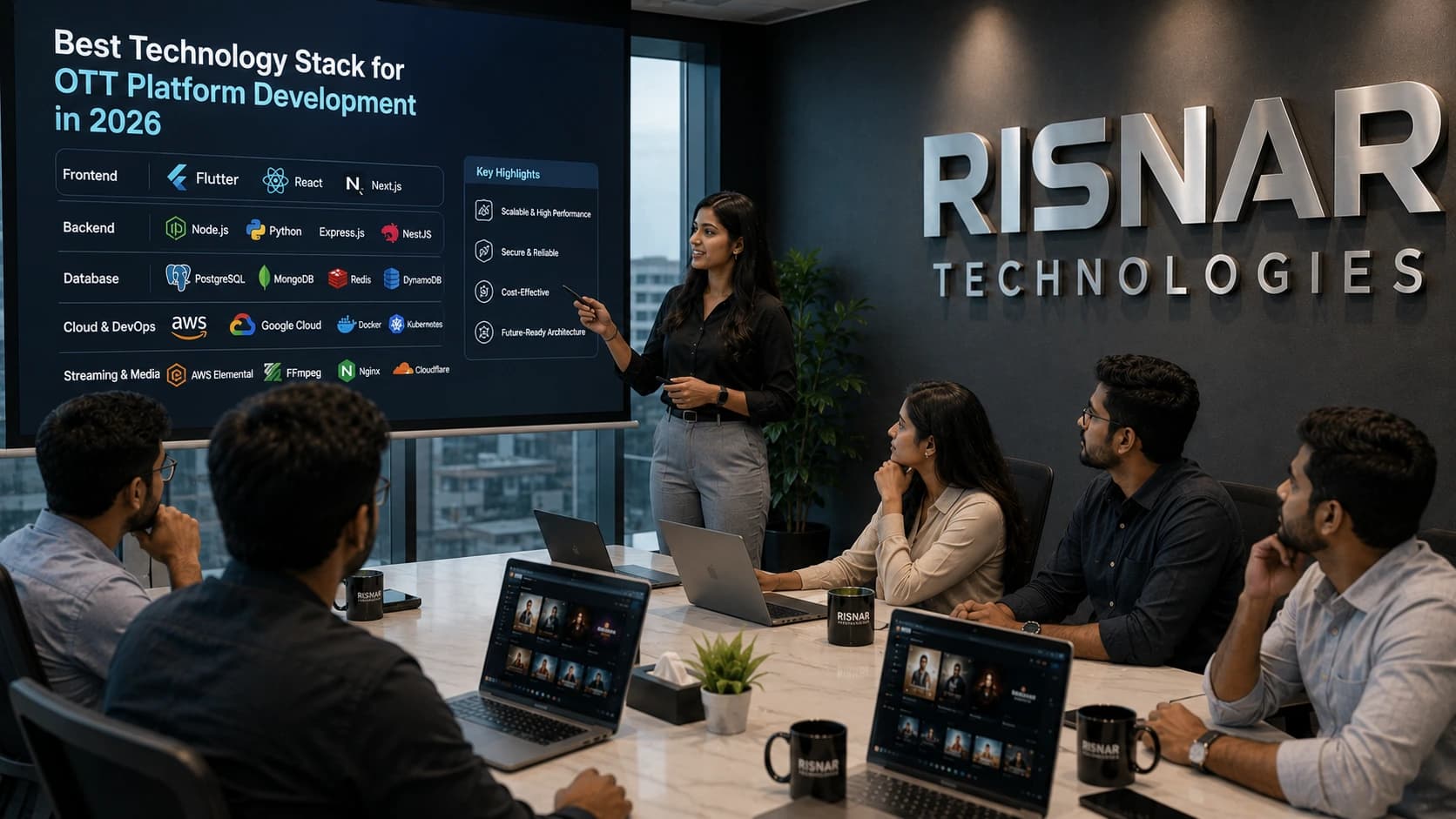
Best Technology Stack for OTT Platform Development in 2026
Every successful OTT platform is built on a strong technology foundation. Selecting the right frontend, backend, cloud services, database, streaming protocols, security tools, and DevOps pipeline helps deliver better performance, smoother video playback, stronger security, and easier future growth. This guide explains the complete OTT technology stack in simple language so you can understand how modern streaming platforms are developed.
What Is an OTT Technology Stack?
Every OTT platform is built using many different technologies that work together like parts of a machine. This complete collection of technologies is called an OTT technology stack. It includes everything needed to build and run a streaming platform, such as the user interface, backend services, databases, cloud servers, video streaming systems, security tools, payment gateways, and analytics. Each technology has a specific job, and together they create a fast, secure, and reliable experience for viewers.
Choosing the right technology stack is one of the most important decisions during OTT platform development. A good technology stack helps videos load faster, reduces buffering, protects premium content, supports millions of users, and makes future updates much easier. On the other hand, choosing outdated or unsuitable technologies can increase development costs, slow down performance, and make it difficult to add new features as your business grows.
Think about popular streaming platforms like Netflix or Disney+. When you open the app, search for a movie, start watching instantly, switch to another device, or receive personalized recommendations, dozens of technologies work together behind the scenes. The user only sees a simple interface, but the technology stack is doing all the heavy work in the background.
In this guide, you'll learn the complete OTT technology stack in simple language. We'll explain the role of frontend development, backend services, cloud infrastructure, databases, CDNs, streaming protocols, security, DevOps, AI, and other important technologies that help build modern OTT platforms in 2026.
Table of Contents
Quick Summary
If you only have a few minutes, this section gives you the most important points about choosing an OTT technology stack. Modern streaming platforms need a combination of powerful frontend frameworks, scalable backend services, cloud infrastructure, secure video delivery, and intelligent monitoring tools. Selecting the right technologies from the beginning helps reduce development costs, improve user experience, and prepare your platform for future growth.
Best Frontend
Flutter & React
Reliable Backend
Node.js & Java
Cloud Platform
AWS, Azure & GCP
Faster Streaming
Global CDN
Strong Security
DRM & Encryption
Long-Term Goal
Scalability
Building an OTT platform is not only about selecting the latest technologies. The real goal is to choose tools that work well together, fit your business requirements, and provide a smooth streaming experience for users. A carefully planned technology stack creates a strong foundation that supports business growth for many years.
Why Choosing the Right Technology Stack Matters
The technology stack is the backbone of every OTT platform. It decides how quickly your application loads, how smoothly videos play, how securely user information is protected, and how easily your platform can grow in the future. Even the best content library cannot keep users engaged if the platform is slow, unreliable, or difficult to use. That's why selecting the right technologies at the beginning of your project is one of the most important business decisions you will make.
Better User Experience
A modern technology stack helps users enjoy fast loading screens, smooth video playback, quick searches, personalized recommendations, and reliable streaming across mobile devices, Smart TVs, tablets, and web browsers.
Easier Future Growth
As your audience grows, your platform should handle thousands or even millions of viewers without slowing down. Scalable cloud technologies make future expansion much easier and reduce costly system upgrades.
Strong Security
Secure technologies protect user accounts, payment information, and premium video content from hackers, piracy, and unauthorized access while helping businesses build customer trust.
Lower Maintenance Cost
Choosing proven technologies reduces technical problems, simplifies software updates, and allows developers to introduce new features more quickly without rebuilding the platform.
Real-World Example
Imagine two companies launching similar OTT platforms. The first company invests in a scalable cloud architecture, CDN, secure streaming, and modern development tools. The second company chooses cheaper technologies that cannot handle heavy traffic. When thousands of users join during a live sports event, the first platform continues streaming smoothly while the second platform experiences buffering, crashes, and unhappy customers. This simple example shows how the technology stack directly affects business success.
Key Takeaway: A good technology stack is more than a technical decision. It improves user experience, supports business growth, reduces operational costs, and creates a strong foundation for long-term success.
Complete OTT Technology Stack Explained
A successful OTT platform combines multiple technologies that work together as one complete ecosystem. Every layer has a different responsibility, from displaying the application interface to streaming videos, storing user information, processing payments, and protecting premium content. Understanding how these layers connect helps businesses choose the right architecture before development begins.
| Technology Layer | Main Responsibility | Popular Technologies |
|---|---|---|
| Frontend | Builds the user interface for mobile, web, and TV apps. | Flutter, React, Next.js |
| Backend | Handles APIs, authentication, subscriptions, and business logic. | Node.js, Java, .NET |
| Database | Stores user accounts, videos, subscriptions, and metadata. | PostgreSQL, MySQL, MongoDB |
| Cloud Infrastructure | Provides scalable computing and storage resources. | AWS, Azure, Google Cloud |
| CDN | Delivers videos quickly from servers near viewers. | CloudFront, Cloudflare |
| DevOps | Automates deployment, monitoring, and scaling. | Docker, Kubernetes, GitHub Actions |
Every technology layer performs a different task, but none of them work alone. The frontend communicates with backend APIs, the backend retrieves information from databases, cloud servers process requests, the CDN delivers video files, analytics collect user activity, and security systems verify access permissions. Together they create one complete streaming platform that feels simple and fast to the user.
How Everything Works Together
Imagine a user opening an OTT application to watch a movie. The frontend displays the home screen and sends a request to the backend. The backend checks whether the user has an active subscription, retrieves movie information from the database, and requests the video from cloud storage. The CDN then streams the video from the nearest server, while analytics record viewing activity and security systems protect the content from unauthorized access. Although the viewer simply presses the "Play" button, many technologies work together within seconds to deliver a seamless experience.
Final Takeaway: The best OTT platforms are built by combining reliable technologies rather than depending on a single framework or programming language. When every layer is carefully planned, the platform becomes faster, more secure, easier to maintain, and ready to support future business growth.
Frontend vs Backend vs Infrastructure
Every OTT platform is built using three major layers: the frontend, the backend, and the infrastructure. These layers work together to create a smooth streaming experience. If even one layer is weak, users may experience slow loading, buffering, login failures, or unexpected downtime. Understanding the role of each layer helps businesses make better technology decisions and build platforms that remain fast, secure, and scalable for years.
Frontend
The frontend is everything users can see and interact with. It includes the home page, movie listings, search, login, subscriptions, video player, profiles, watchlist, and settings. Modern frameworks like Flutter, React, and Next.js help build attractive interfaces that work smoothly across mobile apps, websites, Smart TVs, and tablets.
Backend
The backend works behind the scenes. It manages user accounts, subscriptions, authentication, APIs, recommendations, payment processing, notifications, and content management. Popular backend technologies such as Node.js, Java, and .NET ensure that millions of requests are processed quickly and securely every day.
Infrastructure
Infrastructure provides the foundation that keeps everything running. It includes cloud servers, storage, databases, CDNs, monitoring tools, backups, and security systems. Cloud platforms like AWS, Microsoft Azure, and Google Cloud make it possible to scale resources automatically as viewer traffic increases.
| Layer | Main Purpose | Popular Technologies | Business Benefit |
|---|---|---|---|
| Frontend | User interface and experience | Flutter, React, Next.js | Better engagement and usability |
| Backend | Business logic and APIs | Node.js, Java, .NET | Fast and secure operations |
| Infrastructure | Hosting, storage, networking, scaling | AWS, Azure, Google Cloud | Reliability and scalability |
When a user opens an OTT app, the frontend displays the interface, the backend verifies the user's subscription and retrieves movie details, while the infrastructure delivers the video through cloud servers and a CDN. Although users only see a simple video player, these three layers are continuously communicating to provide smooth, high-quality streaming without interruptions.
Summary: A successful OTT platform requires all three layers to work together. A beautiful frontend cannot compensate for a weak backend, and even the best backend cannot perform well without reliable cloud infrastructure. Building the right balance between these layers creates a platform that is fast, secure, and ready to grow.
Essential Technologies Used in Modern OTT Platforms
Modern OTT platforms depend on many technologies working together. Each one solves a different problem, such as building the user interface, streaming videos, protecting premium content, processing payments, or collecting analytics. Choosing trusted technologies makes development easier and creates a better experience for both viewers and platform owners.
Flutter & React
Used to build responsive mobile and web applications with modern user interfaces and smooth performance.
Node.js & Java
Power backend APIs, authentication, subscriptions, content management, and business logic for OTT platforms.
PostgreSQL & MongoDB
Store user profiles, subscriptions, watch history, playlists, and content metadata safely and efficiently.
Cloud Platforms
AWS, Azure, and Google Cloud provide scalable hosting, storage, networking, and automated resource management.
CDN & Video Streaming
CDNs distribute video files closer to viewers, reducing latency and improving playback quality around the world.
DRM & Security
Encryption, DRM, secure authentication, and access control help prevent piracy and protect premium digital content.
Analytics & AI
AI recommends content while analytics measure user behaviour, watch time, subscriptions, and platform performance.
DevOps Automation
Docker, Kubernetes, and CI/CD pipelines automate deployments, improve reliability, and simplify software updates.
Consider a viewer watching a live football match on an OTT platform. Flutter displays the interface, backend services verify the user's subscription, databases retrieve account information, cloud infrastructure processes requests, the CDN streams the live video, DRM protects the broadcast from piracy, analytics monitor viewer engagement, and DevOps systems ensure everything keeps running without interruption. Although the experience feels simple, many technologies are working together behind the scenes.
Best Practices
- • Choose technologies with strong community support.
- • Design for scalability from the beginning.
- • Prioritize security for users and premium content.
- • Use cloud infrastructure with global CDN integration.
- • Automate testing and deployment using DevOps tools.
- • Continuously monitor platform performance and user behavior.
Final Summary: The best OTT platforms are not built around a single programming language or framework. They combine frontend technologies, backend services, cloud infrastructure, databases, CDNs, security, analytics, and automation into one reliable ecosystem that delivers fast, secure, and enjoyable streaming experiences for users worldwide.
Common Technology Stack Mistakes to Avoid
Building an OTT platform is a long-term investment, so selecting the right technology stack is extremely important. Many businesses focus only on development cost and forget about scalability, security, and future growth. These mistakes may not create problems immediately, but they often become expensive as the platform attracts more users. Understanding the most common technology stack mistakes can help you build a platform that performs well from the first day and continues to grow successfully.
| Common Mistake | Why It Causes Problems | Better Approach |
|---|---|---|
| Choosing outdated technologies | Limits performance, security, and future updates. | Use modern, actively maintained frameworks. |
| Ignoring scalability | Platform slows down as traffic increases. | Build using cloud-native architecture. |
| Weak security | Increases the risk of piracy and data breaches. | Implement DRM, encryption, and secure authentication. |
| Skipping performance monitoring | Problems remain unnoticed until users complain. | Use monitoring and analytics from day one. |
Most of these mistakes happen because businesses focus only on launching quickly or reducing initial development costs. While this approach may save money in the short term, it often leads to higher maintenance costs, slower feature development, and poor user experience later. Modern OTT platforms need flexible architectures that can adapt to changing business requirements and growing viewer expectations.
The best way to avoid these issues is to plan your technology stack before development begins. Choose proven technologies with strong community support, design for scalability, prioritize security, and continuously monitor platform performance. Working with an experienced OTT development company can also help you avoid costly architectural mistakes that are difficult to fix after launch.
Summary: A carefully planned technology stack saves time, reduces maintenance costs, improves platform reliability, and creates a better streaming experience for users. Avoiding these common mistakes gives your OTT platform a much stronger foundation for long-term success.
Future Technology Trends for OTT Platforms
OTT technology continues to evolve every year as viewers expect faster streaming, better recommendations, and richer viewing experiences. Businesses that adopt modern technologies early can improve customer satisfaction, reduce operational costs, and stay ahead of competitors. The following trends are expected to shape the future of OTT platforms beyond 2026.
AI-Powered Personalization
Artificial intelligence will deliver smarter content recommendations, personalized home screens, voice search, and customized viewing experiences based on each user's interests.
Faster Global Streaming
Edge computing, advanced CDNs, and modern streaming protocols will reduce latency and improve video quality for viewers around the world, especially during live events.
Smarter Cloud Infrastructure
Cloud platforms will automatically scale resources based on traffic, helping OTT businesses reduce costs while maintaining reliable performance during peak viewing hours.
Stronger Security
New DRM technologies, AI-based threat detection, and advanced authentication methods will better protect premium content, user accounts, and digital payments from piracy and cyber attacks.
Over the next few years, successful OTT platforms will become more intelligent, automated, and user-focused. Artificial intelligence will improve content discovery, cloud services will simplify infrastructure management, and advanced streaming technologies will deliver smoother viewing experiences across every device. Businesses that invest in modern technologies today will find it easier to adopt these innovations as they become industry standards.
Final Thoughts: Technology trends will continue to change, but the goal remains the same: provide viewers with fast, secure, and enjoyable streaming experiences. Choosing a flexible and future-ready technology stack today ensures your OTT platform can easily adapt to tomorrow's innovations.
OTT Technology Stack Planning Checklist
Before starting OTT platform development, it is important to create a clear technology roadmap. Planning your technology stack early helps reduce development risks, avoid unnecessary costs, and ensure your platform is ready for future growth. Use this checklist to verify that every important technical decision has been considered before development begins.
Define your target audience and supported devices.
Choose the right frontend framework.
Select a scalable backend architecture.
Pick reliable cloud hosting and storage.
Use a global CDN for faster video delivery.
Implement DRM and strong security measures.
Integrate secure payment gateways.
Set up analytics and monitoring tools.
Automate deployment with DevOps pipelines.
Plan for future scalability and feature expansion.
Every OTT business has different goals, budgets, and user expectations. Instead of choosing technologies based only on popularity, select tools that align with your business model and long-term vision. A well-planned technology stack will make future upgrades, feature additions, and performance improvements much easier.
Summary: Completing this checklist before development starts helps create a reliable, scalable, and secure OTT platform that can grow with your business for many years.
Why Choose RISNAR for OTT Platform Development?
Building an OTT platform requires much more than writing code. It requires the right architecture, scalable cloud infrastructure, secure video delivery, and an outstanding user experience. At RISNAR Technologies, we help businesses transform their streaming ideas into modern OTT platforms that are fast, secure, and ready to grow. Our development approach focuses on long-term success, ensuring every platform is designed for performance, scalability, and future innovation.
Complete OTT Expertise
From strategy and UI/UX design to backend development, cloud infrastructure, Smart TV apps, mobile applications, payment integration, and video streaming, our team manages every stage of OTT platform development under one roof.
Future-Ready Technology Stack
We use trusted and modern technologies that support high performance, cloud scalability, content security, AI-powered features, and smooth streaming across Android, iOS, Web, Smart TV, and other connected devices.
Business-Focused Development
Every technical decision is made with your business goals in mind. Whether your platform depends on subscriptions, advertising, rentals, or live events, we build solutions that support sustainable growth and better customer engagement.
Long-Term Partnership
Our relationship doesn't end after launch. We provide ongoing maintenance, performance optimization, feature enhancements, security updates, and technical support to help your OTT platform continue growing as your audience expands.
Why Businesses Trust RISNAR
Businesses choose RISNAR because we combine technical expertise with practical business thinking. Instead of simply delivering software, we build OTT platforms that are designed for scalability, reliability, and long-term success. From MVPs for startups to enterprise-grade streaming solutions, our team focuses on creating products that provide exceptional user experiences while remaining easy to manage and expand.
Whether you're planning a video-on-demand platform, a live streaming service, an education platform, a fitness app, or a niche entertainment network, RISNAR Technologies can help you select the right technology stack and build an OTT platform that is prepared for today's users and tomorrow's opportunities.
Frequently Asked Questions
Here are answers to some of the most common questions businesses ask before selecting the right technology stack for OTT platform development.
1. What is an OTT technology stack?
An OTT technology stack is the complete collection of technologies used to build and operate a streaming platform. It includes frontend frameworks, backend services, databases, cloud infrastructure, video streaming solutions, content delivery networks (CDNs), payment gateways, security systems, analytics, and DevOps tools. Every component works together to provide fast video playback, secure content delivery, and a reliable user experience across mobile apps, websites, and Smart TVs.
2. Which frontend technology is best for OTT app development?
Flutter is one of the most popular choices because it allows developers to build Android, iOS, Web, and Smart TV applications from a shared codebase. React and Next.js are also widely used for web platforms. The right choice depends on your business goals, supported devices, budget, and long-term maintenance requirements rather than simply selecting the newest framework available.
3. Which backend technologies are commonly used for OTT platforms?
Modern OTT platforms frequently use Node.js, Java, or .NET to build secure and scalable backend services. These technologies manage user authentication, subscriptions, APIs, video metadata, payment processing, notifications, and content management. The backend is responsible for handling thousands of user requests efficiently while ensuring data remains secure and available.
4. Why is cloud infrastructure important for OTT platforms?
Cloud infrastructure provides flexible computing power, databases, storage, networking, and automatic scaling. Services such as AWS, Microsoft Azure, and Google Cloud allow OTT platforms to support increasing numbers of viewers without purchasing expensive physical servers. Cloud infrastructure also improves reliability, disaster recovery, and global content availability.
5. Why does an OTT platform need a CDN?
A Content Delivery Network (CDN) stores video files on servers located in different regions around the world. Instead of streaming videos from a single location, viewers receive content from the nearest server. This reduces buffering, improves video quality, decreases loading time, and delivers a better viewing experience during both regular streaming and high-traffic live events.
6. How can OTT platforms protect premium video content?
OTT platforms use multiple security technologies such as DRM (Digital Rights Management), video encryption, secure authentication, token-based access control, and protected streaming protocols. These security measures help prevent unauthorized downloads, account sharing, piracy, and content theft while protecting both business revenue and intellectual property.
7. Can an OTT platform support millions of users?
Yes. A properly designed OTT platform can support millions of viewers by using scalable cloud infrastructure, load balancing, distributed databases, global CDNs, caching systems, and containerized deployments. Planning for scalability from the beginning is much easier and more cost-effective than rebuilding the platform after rapid business growth.
8. How does AI improve OTT platforms?
Artificial intelligence helps OTT platforms recommend movies, TV shows, and live events based on each viewer's interests. AI also improves search results, personalizes home screens, predicts user preferences, detects suspicious activities, and provides valuable business insights through advanced analytics. These features increase viewer engagement and improve customer retention.
9. How do I choose the right technology stack for my OTT platform?
Start by identifying your business goals, target audience, supported devices, expected user traffic, monetization model, security requirements, and future expansion plans. Instead of selecting technologies based only on popularity, choose tools that match your long-term business strategy. Consulting an experienced OTT development company can help you make better architectural decisions.
10. Why should I choose RISNAR for OTT platform development?
RISNAR Technologies specializes in building scalable, secure, and feature-rich OTT platforms using modern technologies. Our team provides complete development services including UI/UX design, frontend and backend development, cloud deployment, video streaming integration, payment systems, security, maintenance, and ongoing technical support. We focus on building platforms that are ready for long-term business growth.
11. How long does it take to develop an OTT platform?
Development time depends on project complexity, supported platforms, custom features, third-party integrations, and design requirements. A basic MVP may take a few months, while a full-featured enterprise OTT platform with live streaming, subscription management, Smart TV applications, analytics, and AI capabilities usually requires a longer development timeline.
12. Is it possible to upgrade the technology stack later?
Yes, but upgrading becomes much easier when the platform is designed with a modular and scalable architecture from the beginning. Modern development practices such as microservices, containerization, and cloud-native infrastructure allow businesses to replace or improve individual components without rebuilding the entire platform. Planning for future upgrades during the initial development phase saves both time and money.
Related Articles
Continue exploring our latest guides and insights.



Ready to Build a Modern OTT Platform?
Whether you're launching a subscription-based streaming service, an education platform, a fitness app, a live TV solution, or a niche entertainment network, choosing the right technology stack is the first step toward long-term success. At RISNAR Technologies, we build secure, scalable, and feature-rich OTT platforms using the latest technologies. Let's discuss your vision and create a streaming solution that delivers exceptional user experiences today while remaining ready for tomorrow's growth.
Last Updated: July 31, 2026