Live Streaming App Development Cost in 2026
Wondering how much it costs to build a live streaming app in 2026? This complete guide explains development costs, pricing factors, essential features, technology choices, and practical budgeting tips to help you estimate the investment required for a successful live streaming platform.
Live Streaming App Development Cost in 2026: Complete Pricing Guide
The cost of developing a live streaming app depends on several factors, including platform selection, app features, UI/UX design, backend infrastructure, video streaming technology, cloud hosting, security, and ongoing maintenance. Whether you're building a simple live streaming application or a feature-rich enterprise platform, understanding these cost drivers helps you create a realistic budget and avoid unexpected expenses during development.
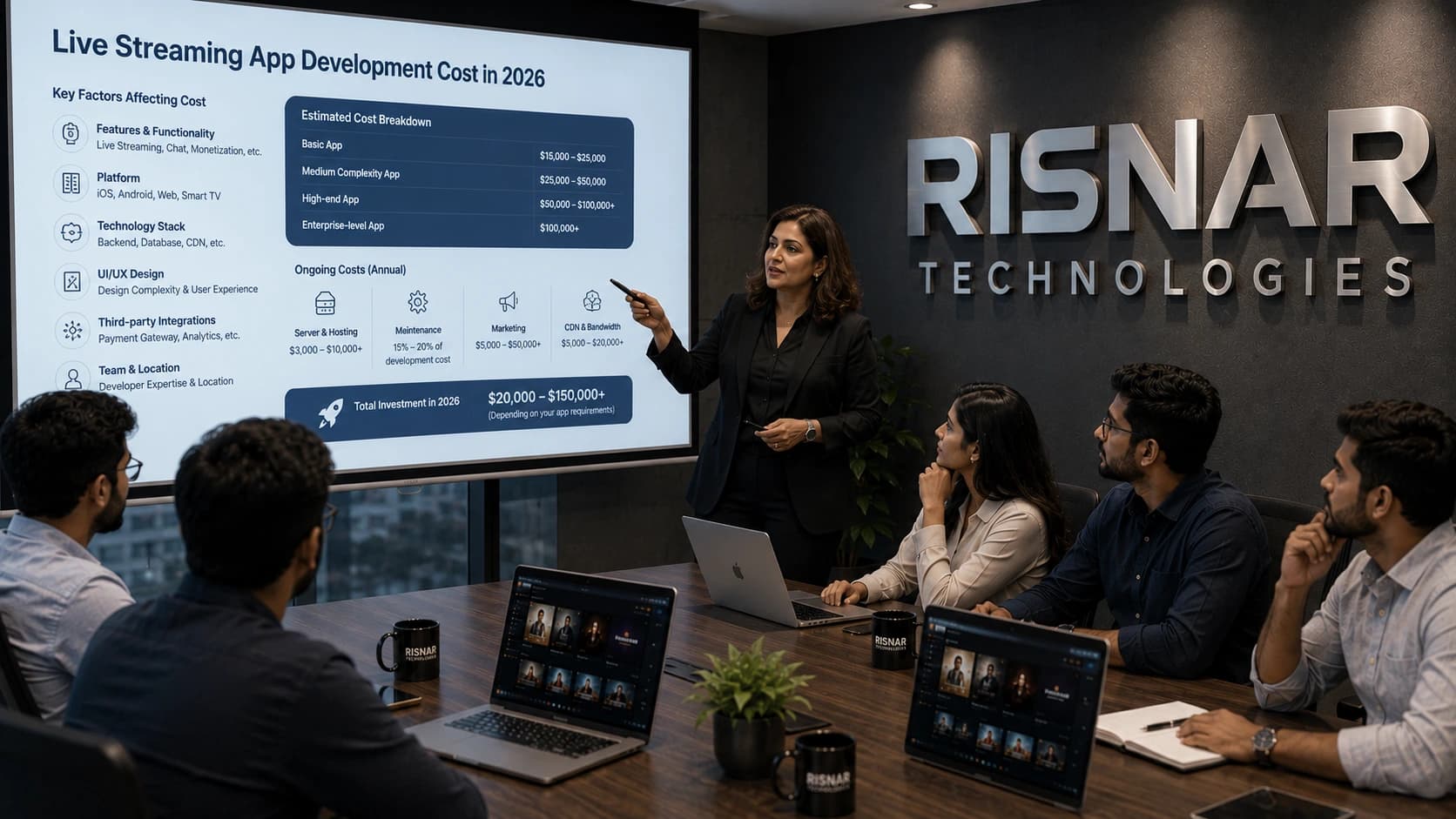
Live Streaming App Development Cost in 2026
Live streaming applications have become an essential part of modern digital businesses. From entertainment platforms and online gaming to education, fitness, social networking, sports, healthcare, and corporate events, businesses are increasingly investing in live streaming apps to connect with audiences in real time. As demand continues to grow, understanding the cost of developing a live streaming app has become one of the most important steps before starting a project.
The total development cost can vary significantly depending on your project requirements. Factors such as supported platforms (Android, iOS, Web, Smart TV), video quality, real-time chat, cloud infrastructure, user authentication, payment integration, content moderation, analytics, scalability, and security all influence the final budget. A simple MVP requires far less investment than an enterprise-grade streaming platform designed for millions of users.
Proper cost planning helps businesses allocate budgets wisely, prioritize essential features, reduce development risks, and avoid unexpected expenses later in the project. Instead of focusing only on the initial development cost, it is equally important to consider long-term expenses such as cloud hosting, CDN services, maintenance, feature updates, monitoring, and ongoing technical support.
In this guide, you'll learn the complete cost breakdown of live streaming app development in 2026, the major factors affecting pricing, the features that increase development costs, practical ways to optimize your budget, common budgeting mistakes, and how to choose the right development partner for your streaming platform.
Table of Contents
Quick Summary
The cost of developing a live streaming app depends on the features, supported platforms, streaming quality, backend architecture, security, scalability, and third-party integrations. While a basic streaming application requires a moderate investment, enterprise platforms with advanced capabilities require significantly larger budgets. The following summary highlights the most important factors that influence overall development costs.
App Complexity
More advanced features such as multi-streaming, AI moderation, and analytics increase development cost.
Supported Platforms
Developing for Android, iOS, Web, and Smart TVs costs more than building for a single platform.
Streaming Infrastructure
Cloud hosting, CDN, transcoding, storage, and bandwidth are major cost components.
Development Team
The size, experience, and location of your development team directly affect project pricing.
Maintenance
Regular updates, cloud services, bug fixes, and feature enhancements add to long-term ownership costs.
Smart Investment
Start with an MVP, validate your idea, and scale gradually to reduce overall development costs.
Careful planning and selecting the right technology partner can help you control development costs while building a scalable and future-ready live streaming platform.
What Affects Live Streaming App Development Cost?
Every live streaming application is unique, which means development costs vary from one project to another. Several technical and business factors determine the overall investment required. Knowing these factors helps businesses estimate realistic budgets before starting development.
Platform Selection
Building separate apps for Android, iOS, Web, and Smart TVs increases development effort and overall cost.
Feature Set
Live chat, subscriptions, monetization, recording, AI moderation, and analytics require additional development time.
Video Infrastructure
Streaming servers, CDN, adaptive bitrate streaming, and cloud storage significantly impact project costs.
UI & UX Design
Custom interfaces, animations, accessibility, and responsive layouts require additional design and development effort.
Security
DRM, encryption, secure authentication, and fraud prevention are essential for protecting premium content.
Scalability
Applications designed for millions of users require more powerful backend infrastructure and larger investments.
Simple Example
A startup building a basic live streaming app with user login and video broadcasting will spend far less than a global streaming platform offering subscriptions, AI recommendations, cloud DVR, live chat, multilingual support, and Smart TV applications.
Key Takeaway: The more platforms, features, integrations, and scalability your app requires, the higher the development cost will be.
Live Streaming App Development Cost Breakdown
Understanding where your budget is spent helps you make better development decisions. The following table highlights the major components that contribute to the total cost of building a live streaming application.
| Component | Cost Impact | Description |
|---|---|---|
| UI/UX Design | Medium | Custom app design and user experience. |
| Frontend Development | High | Android, iOS, Web, and Smart TV apps. |
| Backend Development | High | APIs, authentication, databases, notifications. |
| Streaming Infrastructure | Very High | CDN, transcoding, cloud storage, bandwidth. |
| Testing & QA | Medium | Performance, security, and device testing. |
| Maintenance | Ongoing | Updates, monitoring, bug fixes, and support. |
Understanding the Cost Breakdown
The largest portion of your budget is usually spent on frontend and backend development, followed by streaming infrastructure. Cloud services, bandwidth, storage, and video processing become increasingly important as user numbers grow.
Investing in scalable architecture during the initial development phase often reduces future maintenance costs and makes it easier to support business growth.
Real-World Example
A fitness startup may initially launch with live classes and user registration. Later, it can add subscriptions, AI workout recommendations, Smart TV support, multilingual streaming, and analytics as the business grows.
Final Takeaway: Building an MVP first and expanding features over time is one of the most effective ways to control development costs while preparing for long-term growth.
Features That Increase Live Streaming App Development Cost
The biggest factor affecting the cost of live streaming app development is the number and complexity of features included in the application. Every feature requires UI/UX design, frontend development, backend APIs, database architecture, cloud resources, testing, security implementation, and ongoing maintenance. While a simple streaming app can be developed with a limited budget, enterprise-grade streaming platforms require significantly larger investments because they support millions of users, process massive amounts of video data, and provide seamless streaming experiences across multiple devices. Understanding which features belong to the basic, advanced, and enterprise categories helps businesses prioritize development phases and allocate budgets more effectively.
Basic Features
- User registration and secure login
- User profile management
- Live video broadcasting
- Video playback
- Basic search functionality
- Push notifications
- Categories and playlists
These are the minimum features expected in almost every live streaming application. Although relatively straightforward, developers still need to implement authentication, streaming protocols, responsive interfaces, and reliable APIs. Even these fundamental features require extensive testing to ensure smooth playback across different network conditions and devices.
Advanced Features
- Live chat and emoji reactions
- Subscription management
- Payment gateway integration
- Adaptive bitrate streaming
- Personalized recommendations
- Watch history and favorites
- Analytics dashboard
Advanced features greatly improve user engagement and revenue generation but require considerably more development effort. Real-time messaging, payment processing, recommendation engines, and streaming optimization increase backend complexity while requiring additional cloud infrastructure and continuous monitoring to maintain high performance.
Enterprise Features
- AI-powered content moderation
- Multi-CDN infrastructure
- Cloud DVR
- Digital Rights Management (DRM)
- Multi-language streaming
- Smart TV applications
- Advanced reporting & analytics
Enterprise-level capabilities are designed for platforms serving thousands or even millions of concurrent users. These features demand sophisticated backend architecture, distributed cloud infrastructure, advanced security mechanisms, automated scaling, and dedicated monitoring systems. As a result, they represent the highest portion of the total development budget.
Choosing Features Wisely
One of the most common mistakes businesses make is attempting to build every possible feature before launching their product. Although this approach may appear attractive, it often increases development costs, extends project timelines, and delays market validation. Instead, companies should identify the features that directly solve users' problems and focus on those during the first release.
For example, a startup developing an online education platform might initially launch with live classes, user authentication, video playback, and recorded sessions. Features such as AI-powered recommendations, multilingual support, Smart TV applications, cloud DVR, and advanced analytics can be introduced in later phases as the platform grows and generates revenue.
Summary
Every additional feature contributes to the overall development cost by increasing design effort, development time, cloud infrastructure requirements, quality assurance, security testing, and long-term maintenance. Businesses should avoid feature overload during the initial release and instead adopt a phased development strategy. Starting with essential functionality and expanding the platform over time is one of the most effective ways to control costs while building a scalable, reliable, and competitive live streaming application.
How to Reduce Live Streaming App Development Cost
Developing a live streaming application doesn't necessarily require an unlimited budget. Many successful streaming platforms started with a relatively small investment and expanded gradually as their user base grew. The key is to focus on smart planning instead of trying to build every possible feature from the beginning. By prioritizing business goals, selecting the right technology stack, and adopting a phased development approach, organizations can significantly reduce development expenses without compromising the quality, performance, or scalability of the final product.
1. Start with an MVP
Instead of launching with dozens of premium features, begin with a Minimum Viable Product (MVP). Include only the functionality required to validate your business idea, such as user registration, live streaming, basic video playback, and profile management. This approach reduces initial investment while allowing you to collect valuable feedback from real users.
2. Prioritize High-Value Features
Every additional feature increases development time and cost. Rank features based on business value and user demand. Essential capabilities should be implemented first, while advanced features like AI recommendations, cloud DVR, and Smart TV apps can be introduced in future releases.
3. Choose Scalable Technologies
Selecting a modern and scalable technology stack reduces future redevelopment costs. Building a strong technical foundation from the beginning allows new features to be added efficiently without rebuilding large portions of the application.
4. Use Cloud-Based Infrastructure
Cloud platforms provide flexible pricing based on actual usage. Instead of investing heavily in physical servers, businesses can scale computing power, storage, and bandwidth as traffic grows, resulting in better resource utilization and lower upfront costs.
5. Develop in Phases
Divide the project into multiple development phases. Launch the first version quickly, analyze user behavior, and then invest in additional features that provide measurable business value. Incremental development minimizes financial risk while improving product quality.
6. Reuse Proven Components
Authentication systems, payment gateways, notification services, analytics platforms, and cloud storage solutions already have mature APIs. Leveraging trusted third-party services often costs less than developing equivalent functionality entirely from scratch.
7. Plan for Maintenance Early
Development costs do not end after launch. Budgeting for regular updates, security improvements, cloud hosting, monitoring, and bug fixes from the beginning prevents unexpected financial challenges later in the project lifecycle.
8. Work with Experienced Developers
Experienced development teams understand streaming protocols, cloud infrastructure, performance optimization, and security best practices. Their expertise reduces costly mistakes, minimizes project delays, and delivers a more reliable product from the first release.
MVP Strategy
A Minimum Viable Product is one of the most effective ways to control development costs. Rather than investing in dozens of advanced features before understanding user expectations, businesses can launch a streamlined version of the platform, measure engagement, gather customer feedback, and continuously improve the product. This strategy minimizes financial risk while ensuring future investments are driven by real market demand instead of assumptions.
Practical Example
Imagine a company launching a live fitness platform. Instead of building AI coaching, Smart TV support, multilingual streaming, wearable integration, and advanced analytics before launch, the company first releases live classes, user registration, payment integration, and recorded sessions. After acquiring subscribers, additional premium features are introduced gradually based on user demand and business growth. This phased approach reduces initial investment while creating a sustainable roadmap for expansion.
Best Practices
- Define clear business objectives before development begins.
- Prioritize features based on user value rather than assumptions.
- Build scalable architecture from the very beginning.
- Continuously monitor cloud infrastructure costs.
- Collect user feedback after every major release.
- Improve the platform through incremental feature updates.
Final Recommendation
Reducing live streaming app development cost is not about choosing the cheapest option—it is about making informed technical and business decisions. By launching an MVP, prioritizing essential functionality, selecting scalable technologies, leveraging cloud infrastructure, and partnering with an experienced development company, businesses can significantly lower development expenses while building a secure, high-performance, and future-ready live streaming platform capable of growing alongside their audience.
Common Mistakes That Increase Live Streaming App Development Cost
One of the primary reasons live streaming app projects exceed their planned budgets is poor planning rather than technical challenges. Businesses often focus only on launching quickly and overlook long-term scalability, infrastructure costs, maintenance requirements, and future feature expansion. These decisions may seem reasonable during the early stages of development, but they frequently lead to expensive redesigns, delayed releases, and unexpected operational expenses. Understanding the most common mistakes allows organizations to make better technical and business decisions while keeping development costs under control.
| Common Mistake | Better Approach |
|---|---|
| Building every feature before launch | Release an MVP and expand gradually. |
| Ignoring future scalability | Design cloud-ready architecture from day one. |
| Selecting technology only by initial cost | Evaluate long-term performance and maintenance. |
| Underestimating cloud and bandwidth expenses | Include infrastructure costs in your budget. |
| Skipping quality assurance | Perform comprehensive testing before launch. |
| Hiring inexperienced developers | Partner with experienced streaming specialists. |
Why Do These Mistakes Happen?
These mistakes usually occur because businesses underestimate the technical complexity of live streaming platforms. Decision-makers often compare streaming apps with traditional mobile applications, overlooking the additional infrastructure required for video processing, real-time communication, content delivery networks, adaptive streaming, and cloud scalability. Another common reason is attempting to satisfy every possible user requirement before launching the product, which dramatically increases development time and budget without validating market demand.
How to Avoid These Mistakes
The most effective way to avoid unnecessary expenses is to define clear business objectives before development begins. Start with a realistic feature list, prioritize user needs, and build a Minimum Viable Product instead of a fully featured enterprise platform. Choose scalable technologies, estimate long-term cloud costs, and allocate budgets for maintenance, monitoring, and security from the very beginning. Regular project reviews and close collaboration with experienced developers also help identify risks before they become expensive problems.
Summary
Avoiding common development mistakes is one of the easiest ways to reduce project costs while improving overall product quality. Careful planning, phased development, realistic budgeting, scalable architecture, and experienced technical guidance enable businesses to launch reliable live streaming platforms without unnecessary delays or financial surprises. Investing time in strategic planning before development begins often saves far more money than attempting to fix costly architectural mistakes after launch.
Future of Live Streaming Apps
Live streaming technology continues to evolve rapidly as consumer expectations and internet infrastructure improve worldwide. Faster mobile networks, cloud computing, artificial intelligence, and immersive digital experiences are transforming how businesses deliver live video content. In the coming years, live streaming platforms will become more intelligent, highly personalized, and capable of supporting millions of concurrent users while maintaining exceptional video quality and minimal latency.
AI-Powered Personalization
Artificial intelligence will deliver smarter content recommendations, automated moderation, personalized viewing experiences, and predictive analytics to improve user engagement and retention.
Ultra-Low Latency Streaming
Improvements in streaming protocols and edge computing will make real-time interactions nearly instantaneous, benefiting gaming, sports, online education, auctions, and live commerce platforms.
Multi-Platform Experiences
Future applications will provide seamless viewing experiences across smartphones, tablets, web browsers, Smart TVs, gaming consoles, and wearable devices while synchronizing user progress across every platform.
Interactive Streaming
Live shopping, interactive events, polls, virtual gifting, audience participation, and immersive experiences will become standard features rather than premium additions.
Industry Predictions
As 5G adoption expands and cloud infrastructure becomes more efficient, businesses of every size will increasingly invest in live streaming solutions for education, healthcare, entertainment, fitness, retail, corporate communication, and social networking. Future platforms will rely heavily on AI, automation, advanced analytics, and highly scalable cloud architecture to deliver secure, personalized, and uninterrupted streaming experiences to global audiences.
Final Thoughts
The future of live streaming extends far beyond simply broadcasting video. Modern platforms are evolving into comprehensive digital ecosystems that combine real-time communication, commerce, education, entertainment, and artificial intelligence. Businesses planning their applications today should invest in scalable architecture and future-ready technologies so they can adopt these innovations without requiring expensive redevelopment in the years ahead.
Live Streaming App Cost Planning Checklist
Successful live streaming projects begin with proper planning rather than simply estimating development hours. Before investing in a streaming platform, businesses should evaluate technical requirements, business objectives, infrastructure costs, and future scalability. The following checklist provides a practical framework for preparing an accurate development budget while reducing the risk of unexpected expenses during implementation.
Clearly define your business objectives.
Identify your target audience and expected traffic.
Choose the platforms you want to support.
Prioritize essential MVP features first.
Estimate cloud hosting and CDN expenses.
Plan for security, DRM, and user privacy.
Allocate budget for testing and quality assurance.
Include post-launch maintenance costs.
Plan a phased roadmap for future features.
Choose an experienced development partner.
Budget Planning Advice
Development budgets should never focus solely on the initial release. Businesses should also account for cloud infrastructure, bandwidth, monitoring, software updates, security improvements, customer support, and future feature enhancements. Planning these expenses in advance results in a more realistic investment plan and minimizes financial surprises after launch.
Summary
A structured planning process significantly improves project success while helping businesses control development costs. Following this checklist ensures that technical requirements, infrastructure expenses, security, scalability, and long-term maintenance are considered before development begins, leading to a more predictable budget and a smoother product launch.
Why Choose RISNAR Technologies for Live Streaming App Development?
Selecting the right development partner is just as important as choosing the right technology stack. A well-designed live streaming platform requires expertise in mobile application development, cloud infrastructure, real-time communication, video processing, performance optimization, security, and scalable system architecture. At RISNAR Technologies, we combine technical expertise with practical business experience to build secure, high-performance, and future-ready live streaming applications that help businesses grow with confidence.
Custom Development
Every business has unique requirements. We design and develop fully customized live streaming solutions instead of relying on one-size-fits-all templates. Our platforms are tailored to your industry, target audience, and long-term business goals.
Scalable Cloud Architecture
Our applications are built using modern cloud-native architectures capable of handling increasing traffic without sacrificing performance. Whether you serve hundreds or millions of viewers, your platform remains secure, stable, and highly available.
End-to-End Development
From business consultation and UI/UX design to frontend, backend, cloud deployment, testing, launch, and maintenance, we provide complete development services under one roof, ensuring faster delivery and consistent product quality.
Long-Term Technology Partner
We don't just build applications—we help businesses evolve. Continuous maintenance, feature enhancements, security updates, performance optimization, and technical consulting ensure your platform stays competitive as your business grows.
Why Businesses Trust RISNAR Technologies
Businesses choose RISNAR Technologies because we emphasize transparency, quality, scalability, and long-term success. Every project begins with understanding the client's objectives, estimating realistic budgets, selecting appropriate technologies, and defining a clear development roadmap. Throughout the development process, we maintain open communication, follow modern engineering practices, and deliver solutions that are optimized for security, performance, and future expansion.
Our team has experience building modern digital products across multiple industries, enabling us to recommend practical solutions that balance business requirements with technical feasibility. Whether you are launching a startup MVP, developing a subscription streaming platform, or creating an enterprise-grade broadcasting solution, our goal is to maximize your return on investment while minimizing unnecessary development costs.
Build Your Streaming Platform with Confidence
If you're planning to develop a live streaming application in 2026, partnering with an experienced technology company can make a significant difference in both development cost and project success. RISNAR Technologies helps businesses transform ideas into reliable, scalable, and high-performance streaming platforms using modern technologies, proven development processes, and a client-focused approach. Contact our team today for a personalized consultation and a detailed cost estimate tailored to your specific business requirements.
Frequently Asked Questions
Below are answers to some of the most common questions businesses ask before investing in live streaming app development. These FAQs cover development costs, timelines, technologies, scalability, maintenance, and other important considerations that can help you make informed decisions before starting your project.
1. How much does live streaming app development cost in 2026?
The total cost depends on several factors, including the number of supported platforms, feature complexity, cloud infrastructure, UI/UX design, backend architecture, third-party integrations, and long-term scalability. A basic MVP requires a much smaller investment than an enterprise-grade streaming platform with AI recommendations, Smart TV support, analytics, DRM protection, and multi-language capabilities. Proper planning is the best way to establish a realistic development budget.
2. How long does it take to build a live streaming application?
Development timelines vary according to project scope. A basic MVP with essential streaming functionality can usually be completed much faster than a feature-rich enterprise platform. The overall timeline is influenced by application design, backend development, testing, cloud deployment, security implementation, and the number of supported devices. Launching an MVP first is often the fastest way to enter the market and begin collecting valuable user feedback.
3. Which features are essential for a live streaming app?
Most live streaming applications begin with secure user registration, live broadcasting, video playback, search, notifications, user profiles, and content management. Depending on business goals, additional features such as subscriptions, live chat, payment gateways, analytics, recommendations, multilingual support, or Smart TV applications can be added in future development phases as the platform grows.
4. Why does cloud infrastructure affect development cost?
Live streaming platforms continuously process, store, and distribute video content to users across different locations. Cloud infrastructure provides computing power, storage, transcoding, CDN services, and bandwidth that enable smooth streaming experiences. As audience size increases, cloud resource consumption also grows, making infrastructure planning an important part of the overall development and operational budget.
5. Is it better to build an MVP before developing advanced features?
Yes. Building a Minimum Viable Product allows businesses to validate their ideas with real users before investing heavily in advanced functionality. Instead of spending significant resources on features that users may never need, companies can launch quickly, gather feedback, measure engagement, and expand the platform based on actual customer requirements and business growth.
6. Can a live streaming app support millions of users?
Yes, provided the platform is designed using scalable cloud architecture and modern streaming technologies. Load balancing, content delivery networks, distributed databases, auto-scaling, adaptive bitrate streaming, and performance monitoring all play important roles in ensuring reliable performance during periods of high traffic while maintaining a smooth viewing experience.
7. What ongoing costs should businesses expect after launch?
Post-launch expenses typically include cloud hosting, CDN services, bandwidth, software updates, security improvements, monitoring, technical support, bug fixes, feature enhancements, and ongoing maintenance. Businesses should include these costs in their initial budget because they are essential for ensuring long-term platform stability, security, and performance.
8. Which industries benefit from live streaming applications?
Live streaming technology is widely used across entertainment, online education, fitness, gaming, healthcare, sports, retail, live commerce, religious organizations, social networking, and corporate communication. Businesses in these industries use live streaming to improve audience engagement, expand their digital presence, generate recurring revenue, and provide real-time interactive experiences.
9. How can businesses reduce live streaming app development costs?
The most effective strategy is to prioritize essential features, launch an MVP, adopt scalable technologies, use cloud infrastructure efficiently, and introduce advanced capabilities gradually. Careful planning, phased development, continuous user feedback, and collaboration with experienced developers help businesses maximize return on investment while avoiding unnecessary development expenses.
10. Why choose RISNAR Technologies for live streaming app development?
RISNAR Technologies specializes in developing scalable, high-performance digital platforms tailored to individual business requirements. Our team provides complete development services including consultation, UI/UX design, frontend and backend development, cloud deployment, testing, maintenance, and long-term technical support. We focus on delivering reliable, secure, and future-ready solutions that help businesses grow confidently in the competitive streaming industry.
11. Which platforms should a live streaming app support?
The ideal platform strategy depends on your target audience and business objectives. Many businesses begin with Android and iOS applications because they reach the largest mobile audience. Over time, they expand to web browsers, Smart TVs, tablets, and other connected devices. A phased multi-platform approach helps balance development costs while maximizing audience reach and providing a consistent viewing experience across devices.
12. How do I get an accurate cost estimate for my project?
The most accurate cost estimate is prepared after understanding your business goals, target audience, required features, supported platforms, expected user traffic, integration needs, security requirements, and future scalability plans. Working with an experienced development company ensures these factors are carefully evaluated, resulting in a realistic budget, practical development roadmap, and a solution that aligns with your long-term business strategy.
Related Articles
Continue exploring our latest guides and insights.



Ready to Build a High-Performance Live Streaming App?
Whether you're planning to launch a startup streaming platform, an enterprise broadcasting solution, an online education application, or a subscription-based video service, choosing the right development partner is the first step toward long-term success. At RISNAR Technologies, we design and develop secure, scalable, and feature-rich live streaming applications tailored to your business objectives. Our experts help you estimate development costs, define the right feature roadmap, select scalable technologies, and build future-ready platforms that deliver exceptional user experiences across every device.
Last Updated: July 31, 2026 • This article is reviewed regularly to reflect the latest live streaming technologies, development practices, pricing trends, and industry best practices.